Fellow programmers,
I know this is a little outside your juridistiction, but I was wondering perhaps if you have time, if you could help me with one "procedure". Not in view of math but what would be the best way to take.
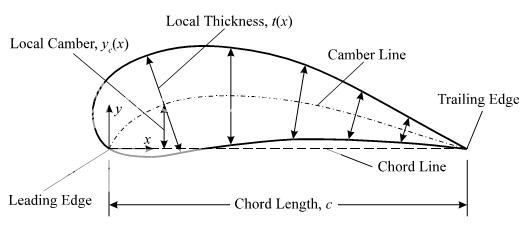

This is an airfoil / profile. Usually, profiles are defined with two sets of data. One is the position of mean camber line, given in the form of x,y where x is usually given in percentages of chord length. Second set of data is thickness at percentages of chord length. Thickness is always drawn perpendicular to the camber line(!), and that gives the profile points.
Now, I have a reverse problem - I have points of a profile, and I need to determine the position of the camber line. Method of interpolation through points can vary, but it doesn't matter, since I can always interpolate as many points as I need, so it comes to linear in the end.
Remember, since the thinkness is drawn perpendicular to the camber line, the position of camber line is not mean between the points of upper and lower line of profile (called the back and face of profile).
Edit (how this is done on paper): Uhh, painfully and in large scale (I'm talking long A0 paper here, that is 1189x5945mm on a large drawing desk. You start by drawing a first camber line (CL) iteration through the midpoints (mean points) between the points of face and back at same x ordinates. After that you draw a lot of perpendicular lines, perpendicular to that CL, and find their midpoints between face and back (those points on face and back will no longer have same x values). Connect those, and that is your second iteration CL. After that you just repeat the second step of the procedure by drawing perpendicular lines onto that 2nd CL ... (it usually converges after 3 or 4 iterations).