Alex Rivera | Logout

How to determine maximum stack usage?

Asked 2008-12-23T15:50:36.313
53

What methods are available for determining the optimum stack size for embedded/memory constrained system? If it's too big then memory is wasted that could be used elsewhere. However, if it is too small then we get this website's namesake...

To try to jump start things: Jack Ganssle states in The Art of Designing Embedded Systems that, "With experience, one learns the standard, scientific way to compute the proper size for a stack: Pick a size at random and hope." Can anyone do better than that?

A more specific example was requested. So, how about a C program targeting an MSP430 MCU with 2 kB of RAM using the IAR Embedded Workbench toolchain without an operating system? This IDE can display the stack contents and usage while using a JTAG debugger.
Edit
Report

1 Answer

23

You tagged your question with static-analysis, but this is a problem that is difficult to solve through static-analysis. The stack usage depends on the program's runtime profile, especially, if you're using recursion or alloca. Given that this is an embedded platform I guess it's also difficult to run something like ps or top and see how much stack your application is using.

An interesting approach is to use the address of the current stack frame in order to determine how much stack is used. You can do this by taking the address of a function's argument or local variable. Do that for the main function and for functions you think are using the most stack. The difference will tell you the amount of stack your application requires. Here is an example (assuming customary high-to-low stack growth).

char *stack_top, stack_bottom;

int
main(int argc, char *argv[])
{
    stack_top = (char *)&argc;
    // ...
    printf("Stack usage: %d\n", stack_top - stack_bottom);
}

void
deeply_nested_function(void)
{
    int a;
    stack_bottom = (char *)&a;
    // ...
}

If your compiler allows you to specify a custom function prologue (many do it to allow graph-based program profiling), you can even arrange for all functions to call such measuring code. Then your measurement function mecomes something like

void
stack_measurement_function(void)
{
    int a;
    stack_bottom = min(stack_bottom, (char *)&a);
    // ...
}

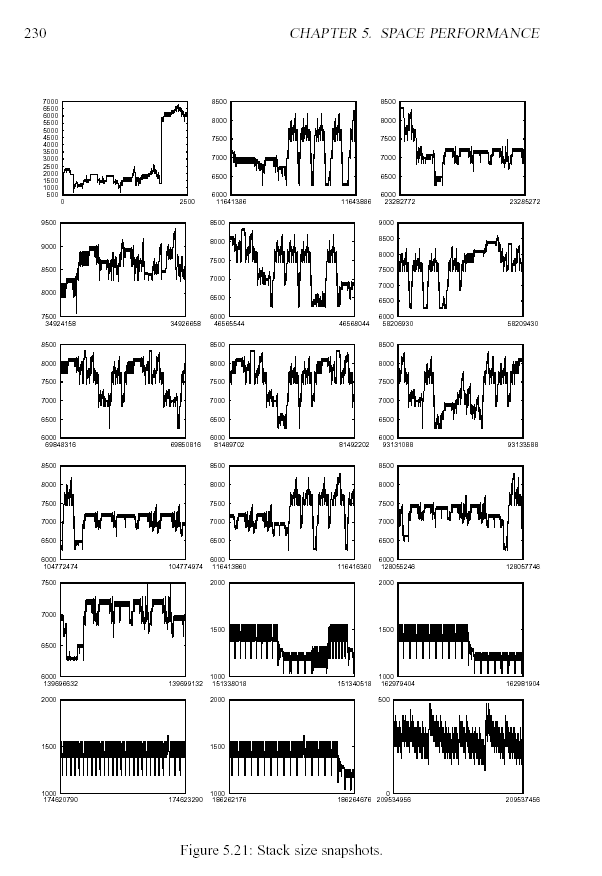
I used an approach similar to what I've described to generate these charts.

answered 2008-12-23T16:13:35.237

Your Answer