Alex Rivera | Logout

HOG Trilinear Interpolation of Histogram Bins

Asked 2011-07-03T20:35:30.510
9

I am working on Histogram of Oriented Gradient(HOG) features and I am trying to implement the trilinear interpolation of histogram bins as described in Dalal's PhD thesis. And he explains the interpolation process as cited below:

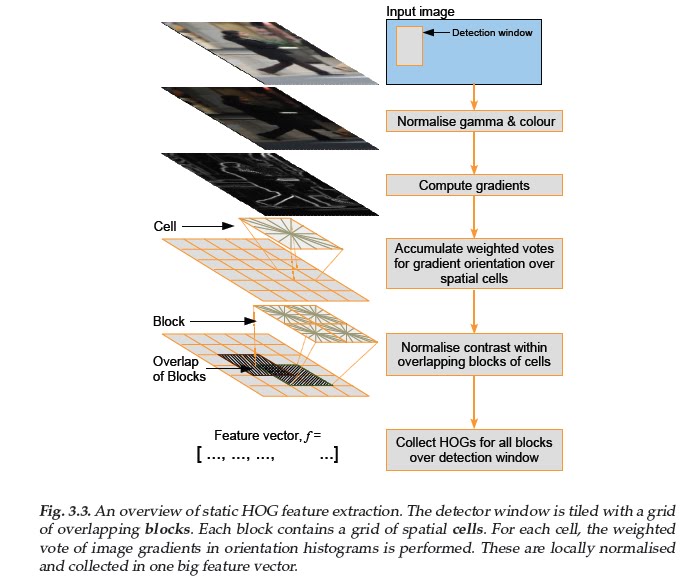
EDIT: Roughly speaking, HOG features are extracted from a 64x128 pixel window which is divided into blocks. Each block consists of 2x2 cells and a cell is 8x8 pixel area. Extraction starts with calculating first order derivatives of image, then orientation and magnitude of each pixel are calculated. An orientation histogram within the block for each 8x8 pixel cell is calculated where pixels contribute to the histogram with the magnitude value, based on the orientation of the pixel, and magnitude is interpolated between the neighbouring bin centres in both orientation and position. Histogram contains 9 bins represents 0-180 degrees with stride of 20 degrees. An overall depiction of the algorithm can be seen here: http://4.bp.blogspot.com/_7NBDeKCsVHg/TKBbldI8GmI/AAAAAAAAAG0/G-OXUz1ouPQ/s1600/a1.bmp

We first describe linear interpolation in a one dimension space and then extend it to 3-D. Let h be a histogram with inter-bin distance(bandwidth) b. h(x) denotes the value of the histogram for the bin centred at x. Assume that we want to interpolate a weight w at point x into the histogram. Let x1 and x2 be the two nearest neighbouring bins of the point x such that x1 ≤ x < x2. Linear interpolation distributes the weight w into two nearest neighbours as follows linear interpolation

Let w at the 3-D point x = [x, y, z] be the weight to be interpolated. Let x1 and x2 be the two corner vectors of the histogram cube containing x, where in each component x1 ≤ x < x2. Assume that the bandwidth of the h

Edit
Report

1 Answer

5

Think of (x1, y1, z1) and (x2, y2, z2) as two points spanning a cube that surrounds the point (x,y,z) for which you want to interpolate a value of h. The set of eight points (x1, y1, z1), (x2, y1, z1), (x1, y2, z1), (x1, y1, z2), (x2, y2, z1), (x2, y1, z2), (x1, y2, z2), (x2, y2, z2) forms the complete cube. So trilinear interpolation between (x1, y1, z1) and (x2, y2, z2) actually means interpolation between the 8 points in the 3D histogram space surrounding the point you are interested in! Now to your questions:

(x1, y1), (x2, y2) (and (x1,y2) and (x2, y1) represent the centers of bins in the (x,y) plane. In your case these would be the orientation vectors.

z1 and z2 represent two bin levels in the orientation direction, as you say. Combined with the four points in the image plane this gives you a total of 8 bins.

The bandwidth b=[bx, by, bz] is basically the distance between the centers of neighbouring bins in the x, y and z direction. In your case, with 8 bins in the x-direction and 64 pixels in that direction, 16 bins in the y direction and 128 pixels in the y direction:

bx = 8 pixels
by = 8 pixels

This leaves bz, for which I actually need more data, because I don't know the full range of your gradient (i.e. lowest to highest possible value) but if that range is rg then:

bz = rg/9

In general, the bandwidth in any direction equals the full available range in that direction divided by the number of bins in that direction.

For a good explanation of trilinear interpolation with pictures look at the link in whoplisp's answer.

answered 2011-07-03T21:51:02.933

Your Answer