In the book Game Coding Complete, 3rd Edition, the author mentions a technique to both reduce data structure size and increase access performance. In essence it relies on the fact that you gain performance when member variables are memory aligned. This is an obvious potential optimization that compilers would take advantage of, but by making sure each variable is aligned they end up bloating the size of the data structure.
Or that was his claim at least.
The real performance increase, he states, is by using your brain and ensuring that your structure is properly designed to take take advantage of speed increases while preventing the compiler bloat. He provides the following code snippet:
#pragma pack( push, 1 )

struct SlowStruct
{
    char c;
    __int64 a;
    int b;
    char d;
};

struct FastStruct
{
    __int64 a;
    int b;
    char c;
    char d;
    char unused[ 2 ]; // fill to 8-byte boundary for array use
};

#pragma pack( pop )
Using the above struct objects in an unspecified test he reports a performance increase of 15.6% (222ms compared to 192ms) and a smaller size for the FastStruct. This all makes sense on paper to me, but it fails to hold up under my testing:
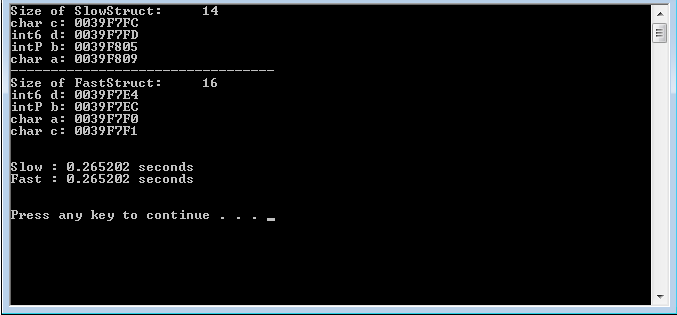
Same time results and size (counting for the char unused[ 2 ])!
Now if the #pragma pack( push, 1 ) is isolated only to FastStruct (or removed completely) we do see a difference:
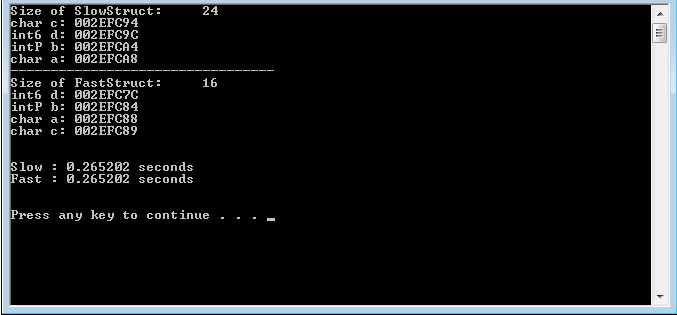
So, finally, here lies the question: Do modern compilers (VS2010 specifically) already optimize for the bit alignment, hence the lack of pe